1. Sourcing as a Competitive Advantage
In the global B2B sector, your brand is only as strong as your weakest supplier. Sourcing is the bedrock of Halal integrity. For U.S. manufacturers, managing a complex web of international vendors requires a sophisticated sourcing strategy that balances cost, speed, and absolute purity.
2. The Multi-Tier Sourcing Challenge
Modern products are composed of hundreds of sub-components.
- **Primary Ingredients:** The meat, dairy, or grains that are easily tracked.
- **Secondary Derivatives:** The emulsifiers, stabilizers, and flavorings that are often the source of non-compliance.
- **Processing Aids:** Substances like filter aids or lubricants that don’t appear on the label but can compromise the Halal status of a facility.
3. Developing a High-Integrity Supplier Qualification Program
- **Tier 1 Audit:** On-site inspection and certificate verification.
- **Tier 2 Technical Review:** Analyzing the manufacturing process of the ingredient itself.
- **Tier 3 Raw Material Traceability:** Verifying the source of the source (e.g., where did the gelatin’s raw material come from?).
4. The Shift Toward “Certified Corridors”
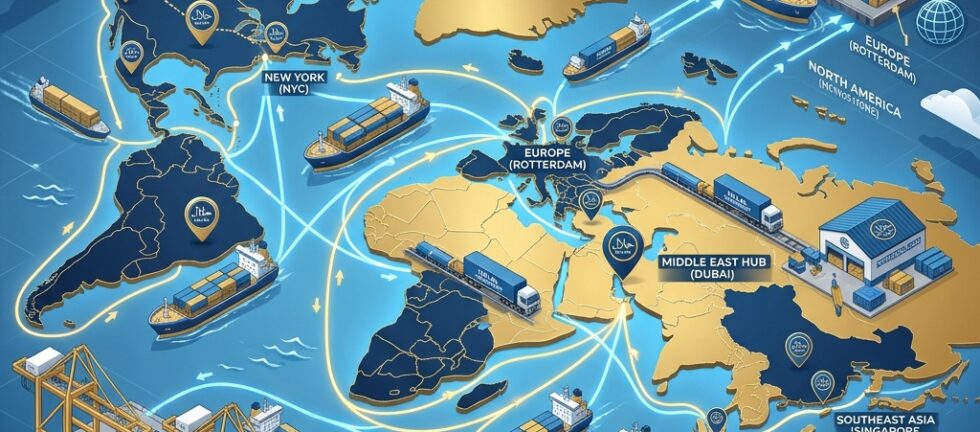
Strategic B2B leaders are moving toward sourcing from “Certified Corridors”—regions like the GCC and Malaysia that have highly mature Halal ecosystems. This reduces the risk of sourcing from “unverified” or “high-risk” zones.
5. Contractual Protections: The “Halal Clause”
Corporate legal teams must integrate specific Halal compliance clauses into all supplier contracts.
- **Immediate Termination Rights:** If a supplier’s certification is revoked or if porcine DNA is detected.
- **Audit Access:** The right to conduct unannounced third-party audits of the supplier’s facility.
- **Liability for Recalls:** Ensuring that suppliers bear the financial burden if their non-compliance leads to a market-level recall.
6. Sustainable and Ethical Sourcing (Tayyib)
The modern Halal consumer is increasingly looking for “Halal + Ethical.” This means sourcing from suppliers who practice fair trade, avoid child labor, and have a low carbon footprint.
7. Supply Chain Visibility Tools
- **Control Towers:** Digital dashboards that show the certification status of every supplier in real-time.
- **Predictive Risk Mapping:** Using AI to identify suppliers who are at high risk of losing their certification based on local regulatory changes.
FAQ: CORPORATE SOURCING STRATEGY
**Q: How do we handle “Dual Sourcing” (one Halal, one non-Halal)?**
A: This is extremely high risk for corporate brands. The best practice is to move toward 100% Halal sourcing to eliminate the possibility of cross-contamination in the warehouse or production line.
**Q: Can we rely on “Equivalent” certifications?**
A: Only if they are formally recognized by the destination market’s regulatory body. Circle H helps manufacturers map these equivalencies to ensure global compliance.
Grow Your Business with Global Halal Certification
Connect with millions of new consumers and ensure your products meet the highest standards of purity. Let Circle H International guide you through a seamless certification journey.