

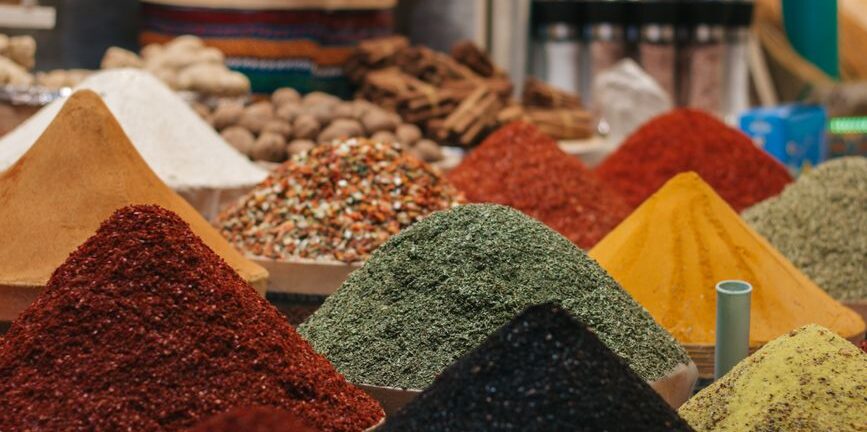
Ask how big the global halal food market is and you will get at least three different answers, each of them correct, because each measures something different. One answer counts what Muslim consumers spend across the whole halal economy. Another counts what they spend on food alone. A third counts what OIC member countries import. A market entry report published in July 2026 by DinarStandard puts all three on the table, and the differences between them are not pedantry: they decide which opportunities are real for a United States or Canadian food exporter, and which are just large numbers. This article reads the report’s market overview section the way we read it as a certifier working with exporters: what the market is, why it is growing now, where the demand actually sits, and what that means before a company spends money on certification.
1. One Market, Three Honest Measurements
The headline figure is the broadest. The report estimates consumer spending across the entire Islamic or halal economy at $2.6 trillion in 2024, spread across six real economy sectors and about two billion Muslim consumers, with year on year growth of 7% between 2023 and 2024 and a projection of $3.56 trillion by 2029. That number includes far more than food: modest fashion, Muslim friendly travel, halal pharmaceuticals, halal cosmetics, and media and recreation all sit inside it.
The second figure isolates food. Halal food consumer spending is estimated at about $1.53 trillion in 2025, projected to reach about $2.06 trillion by 2029, a compound rate of 6.2% a year. Food is by far the largest of the six sectors, which is why the whole economy conversation so often becomes a food conversation.
The third figure is the one an exporter should watch most closely, because it measures cross border trade rather than domestic consumption: the report puts OIC imports of halal food at about $302 billion, within $421.5 billion of OIC imports across halal related sectors. Consumer spending tells you the market exists. Import value tells you how much of it is actually served by foreign suppliers, which is the only slice an exporter can win.
Three Ways to Measure the Same Market
$2.6 trillion
Consumer spending, all six halal economy sectors, 2024
$1.53 trillion
Halal food consumer spending, 2025
$302 billion
OIC halal food imports, the cross border slice
Source: DinarStandard market entry report, July 2026. Three different measures, not additive: total consumer spending, food consumer spending, and OIC import value. Halal food spending is projected to about $2.06 trillion by 2029.
2. The Six Sectors Behind the Trillions
The sector breakdown matters for perspective. Food dominates the halal economy, but it is not the fastest growing part of it. The report’s figures show halal food spending of $1,525 billion in 2025 rising to $2,058 billion in 2029, while modest fashion moves from $347 billion to $444 billion, media and recreation from $276 billion to $364 billion, Muslim friendly travel from $249 billion to $424 billion, halal pharmaceuticals from $112 billion to $146 billion, and halal cosmetics from $92 billion to $124 billion. Travel is the growth outlier at 11.2% a year, recovering and expanding fastest, while food compounds at a steadier 6.2% from a far larger base.
For a food company, the takeaway is reassuring rather than disappointing: food is the anchor sector. Its demand is not a trend cycle, it is the daily consumption of a consumer base the report sizes at two billion people, and its growth rate applies to the biggest number in the table.
| Halal economy sector | Spending 2025 | Projected 2029 | Growth a year |
|---|---|---|---|
| Halal food | $1,525B | $2,058B | 6.2% |
| Modest fashion | $347B | $444B | 5.1% |
| Media and recreation | $276B | $364B | 5.7% |
| Muslim friendly travel | $249B | $424B | 11.2% |
| Halal pharmaceuticals | $112B | $146B | 5.4% |
| Halal cosmetics | $92B | $124B | 6.3% |
Consumer spending by sector, DinarStandard market entry report, July 2026.
3. What Is Driving the Growth
The report groups the drivers of the halal economy into demand side and supply side forces, and both sides are structural rather than fashionable. On the demand side: a growing and young Muslim population, rising affluence among Muslim consumers, a values driven lifestyle that increasingly shapes global brand involvement, digital connectivity that makes halal products findable and discussable, and the intersection of Islamic values with sustainable and ethical consumerism, which pulls halal considerations into purchasing decisions far beyond any single community.
On the supply side, the report points to government bodies functioning as enablers, national Islamic economy strategies, global brand involvement, rising Islamic economy investment activity, and a rise in trade agreements and intra OIC trade. Underneath both sides sits the values foundation the report names explicitly: justice and equity, social responsibility, modesty, moderation, and family values. The practical reading for an exporter is that this demand is institutionalized. It is carried by demography, by state policy, and by retail infrastructure at the same time, which is what separates a market from a moment.
4. Why Now: Tailwinds and Headwinds
The report is unusually honest about the counterforces, and the honesty is useful. On the tailwind side, it notes that the United States is the world’s fourth largest food exporter, home to top global food and pharmaceutical players, that halal demand is outpacing overall food trade growth, and that the market has proven resilient even through shocks in Southeast and South Asia. On the headwind side, it names costly and fragmented halal compliance and certification, importers nearshoring to regional supply chains, and an OIC push for domestic self sufficiency.
Read together, the two lists describe the actual shape of the opportunity. Demand is growing faster than general food trade, but access to that demand is gated by compliance infrastructure, and some of the growth will be captured by regional suppliers rather than distant ones. The window is real, and it rewards companies that treat certification as market infrastructure rather than paperwork. It does not reward waiting for the complexity to disappear, because the fragmentation the report lists as a headwind is itself one of the reasons prepared exporters face less competition than the raw demand figures suggest.
5. Who Sells In, and Who Buys
On the supply side of the trade map, the report ranks the top five exporters to the OIC as Brazil at $33.3 billion, China at $32.6 billion, India at $28.7 billion, the United States at $21 billion, and Türkiye at $18.7 billion, together holding a 32% share of exports to the bloc. The United States, in other words, is already the fourth largest supplier into these markets at roughly 5% of the total. This is not a market American exporters need to break into from zero; it is one where they already operate below their potential share.
On the demand side, the five largest OIC importers are Saudi Arabia at $46.9 billion, the UAE at $43.7 billion, Türkiye at $32.9 billion, Indonesia at $31.5 billion, and Malaysia at $30.6 billion. Three of the five are Gulf or wider Middle East markets, and the same names recur across the category detail, which is what makes them the natural first targets for an export program.
The Five Largest OIC Import Markets (US$ billion)
Source: DinarStandard market entry report, July 2026. Import values across halal related sectors; bars share one scale.
6. Where Growth and Volume Sit Together
Inside food, the report’s category table rewards a careful read. It measures total OIC trade value in 2023, every supplier and not only certified product, against the compound growth rate of those imports from 2018 to 2023. The striking pattern is that scale and momentum now sit in the same categories. Fats and oils are the largest food import category in the table at about $29.2 billion, and they still grew at 8.2% a year. Sugars and sugar confectionery follow at about $19.9 billion, growing fastest of all at 8.5%. Beverages and vinegar are much smaller at about $3.4 billion, but still grew at 6.2%. The categories exporters most associate with halal trade tell the opposite story: meat and edible offal, the third largest category at about $15.8 billion, grew at only 2.5%, and dairy products, nearly as large at about $15.6 billion, actually contracted, shrinking 1.8% a year over the same period.
That inversion is the commercial signal. The usual pattern in trade data is growth in small categories while the giants stand still. Here the two largest categories are also two of the three fastest growing, so an exporter does not have to choose between volume and momentum: the buyers expanding their supplier lists fastest are already among the biggest buyers. The report’s point is not that meat or dairy are unattractive; at close to $16 billion each they remain substantial markets. It is that the fastest expansion sits in the ingredient and input categories rather than in finished animal protein. We broke down what the three fast growing categories mean for plant preparation, ingredient risk, and certification scope in a companion article, and the same caution applies everywhere in this table: category figures are total OIC imports, broader than verified halal certified sales.
7. Who Buys the Fastest Growing Categories
The report goes one level deeper and names the leading OIC import markets for each of the three fast growing categories. For animal and vegetable fats and oils, the top buyers include Pakistan, Türkiye, Iran, Malaysia, and Egypt, followed by Bangladesh, Saudi Arabia, Morocco, Djibouti, and Algeria. For sugars and confectionery, the list runs Indonesia, Malaysia, Saudi Arabia, Bangladesh, and the UAE, then Morocco, Nigeria, Algeria, Iraq, and Sudan. For beverages and vinegar, it is the UAE, Türkiye, Malaysia, Kazakhstan, and Iraq, then Kuwait, Morocco, Saudi Arabia, Nigeria, and Jordan.
The pattern across all three lists is the report’s own conclusion: demand clusters in a familiar set of markets. Türkiye, Malaysia, Saudi Arabia, the UAE, and Indonesia recur across every category, a concentrated set of entry targets rather than a scatter of unrelated countries. For an exporter, that concentration is operationally meaningful. Five destination systems cover the core demand for all three categories, which means five sets of import rules, five recognition regimes for halal certificates, and five label regimes to master, not fifty.
8. The Pathways Already Exist
One more page of the report deserves attention because it answers the skeptic’s question. United States and Canadian agri food exporters already supply the OIC’s largest halal markets today: soyabeans, nuts, wheat and meslin, and dried leguminous vegetables already flow into Indonesia, the UAE, Saudi Arabia, Türkiye, Malaysia, Bangladesh, and Algeria. The trade lanes, the inspection relationships, and the buyer networks exist and carry volume now.
What is newer is the move up the value chain, from bulk commodities into branded, processed, and packaged foods, where halal certification stops being a slaughterhouse question and becomes a formulation, sourcing, and documentation question. That shift is precisely where certification work concentrates: not in proving that a soybean is halal, but in proving that a sauce, a shortening, a confectionery line, or a beverage system is, and in documenting it to the standard a foreign regulator or retail buyer will accept.
9. A Straight Word About Indonesia
Indonesia appears repeatedly in this data, as the fourth largest OIC importer overall and as a top market for sugars and confectionery. It deserves a direct note. Indonesia operates its own national halal product assurance system under BPJPH, and acceptance of foreign certificates there follows its own recognition arrangements rather than any general rule. Circle H does not hold Indonesian accreditation, and nothing in this article should be read as implying that our certificates are accepted in that market. Where Indonesia is the target, the correct path is to verify the current recognition status on BPJPH’s official channels before committing to anything. The size of the Indonesian numbers in the report makes that verification more important, not less.
10. What This Means Before You Certify
Market overviews earn their keep only when they change a decision, and this one changes several. First, the demand is structural and measured in trillions of consumer spending and hundreds of billions of imports, so the question for an exporter is not whether the market exists but whether their products can access it compliantly. Second, the growth concentrates in ingredient categories and in a recurring set of destination countries, so a certification scope should be chosen with those categories and those destinations in mind rather than as an afterthought. Third, the headwinds the report names, fragmented compliance above all, are exactly the obstacle a competent certification process removes, which is why companies that prepare early face thinner competition than the headline demand implies.
Our role in that picture is specific. A halal certificate does not create the market, and no market figure is a sales guarantee for any company. What certification does is convert eligibility into evidence: a documented audit of your product, your process, and your supply chain that a buyer, an importer, or a destination regulator can rely on. The markets described here verify that evidence through their own recognition systems, so the practical sequence is unchanged from everything else we publish: choose the destination, confirm what its system recognizes, certify against that scope, and keep the documentation current. The opportunity the report measures is large. Capturing any part of it starts considerably smaller, with one product, one destination, and one verified certificate.
Sources and Further Reading
- DinarStandard, How U.S. and Canada Food Companies Can Enter the $302B Global Halal Food Market, July 2026. All market figures in this article reflect this report’s July 2026 publication date and should be rechecked against newer data before major commercial decisions.
- Circle H International, Halal Certification for Fats and Oils, Sugars and Beverages: Product Opportunities and How to Prepare
- Circle H International, Where a Halal Certificate Fits in Each Country’s System: What It Covers and What Still Needs Checking
- USDA Foreign Agricultural Service, Saudi Arabia halal regulations and certification body accreditation, October 2026
- Standards and Metrology Institute for Islamic Countries, OIC/SMIIC 1:2019 General Requirements for Halal Food
Circle H International
Ready to Start Your Halal Certification?
Circle H International certifies products, facilities, and supply chains against international halal standards. Submit a certification request to get started.
